How TV Antennas Work
- Nov 17 2026
- /
- 15
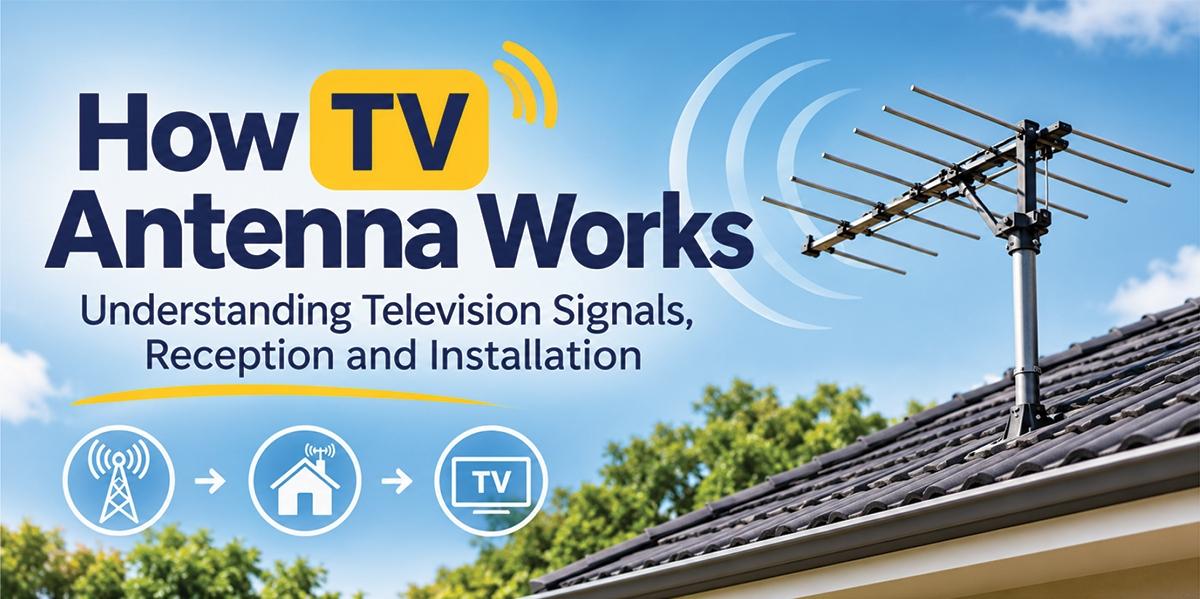
Television has become an everyday part of modern life, but have you ever wondered how your favourite free-to-air channels actually reach your screen? While streaming services and internet-based entertainment have become increasingly popular, traditional television antennas remain an important part of many Australian households.
A TV antenna may look like a simple arrangement of metal rods mounted on a rooftop, but it plays an important role in receiving broadcast signals and delivering them to your television. From capturing electromagnetic waves to transferring digital information through household cables, several components work together to make television reception possible.
Understanding how TV antennas work can also help homeowners identify reception problems, maintain their existing systems and make informed decisions when installing or upgrading their television connections.
A television antenna works by capturing electromagnetic waves transmitted through the air by television broadcasting stations. These waves carry the audio and video information needed to display television programmes. The process involves four basic steps:
Note: An antenna does not create television programmes or generate broadcast signals. Its purpose is to capture signals transmitted by broadcasting stations and deliver them to a television receiver.
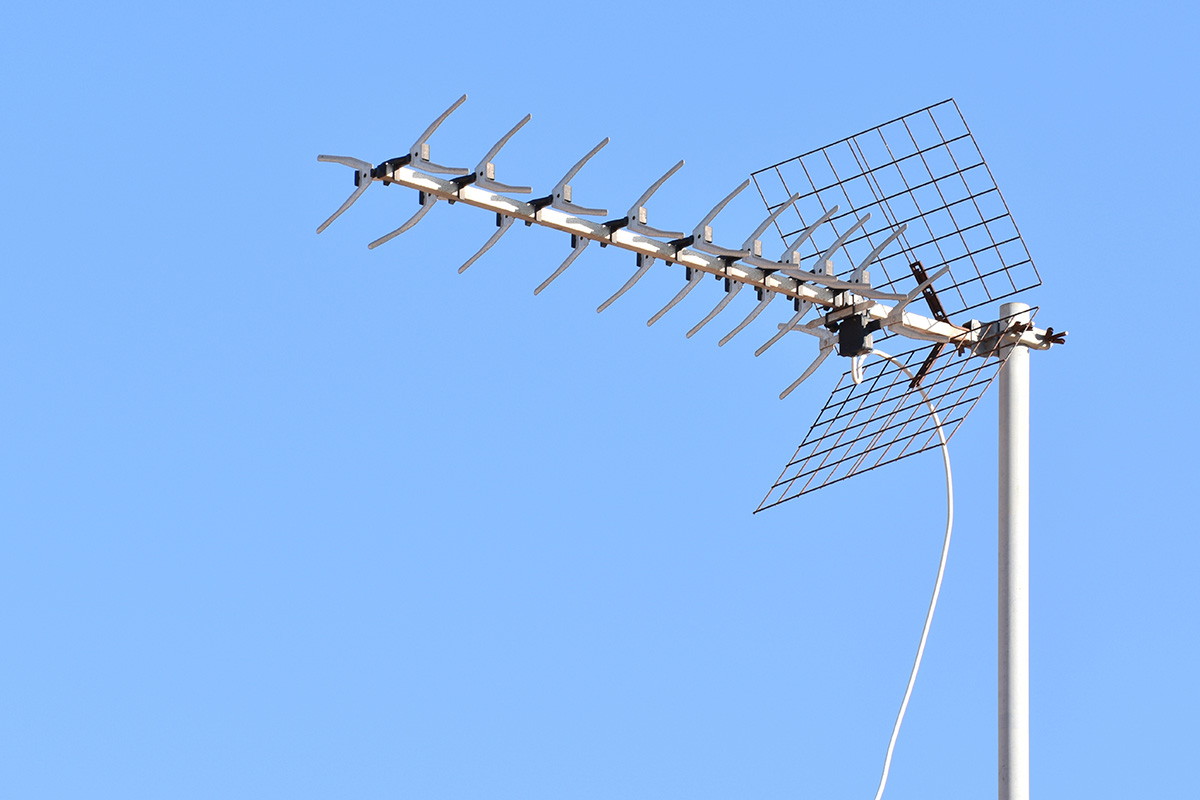
Australian free-to-air television is broadcast across two main frequency bands, each with different characteristics that affect antenna design and performance:
Both frequency bands have different propagation characteristics, and the appropriate antenna depends on the broadcasting frequencies available in a particular area. In Australia, digital terrestrial television services operate across both VHF and UHF frequencies, meaning homeowners need an antenna that is compatible with the channels transmitted by their local broadcasting stations.
Receiving a broadcast signal is only one part of the process. Once the antenna captures the signal, it must be transferred through a household distribution system before reaching the television.
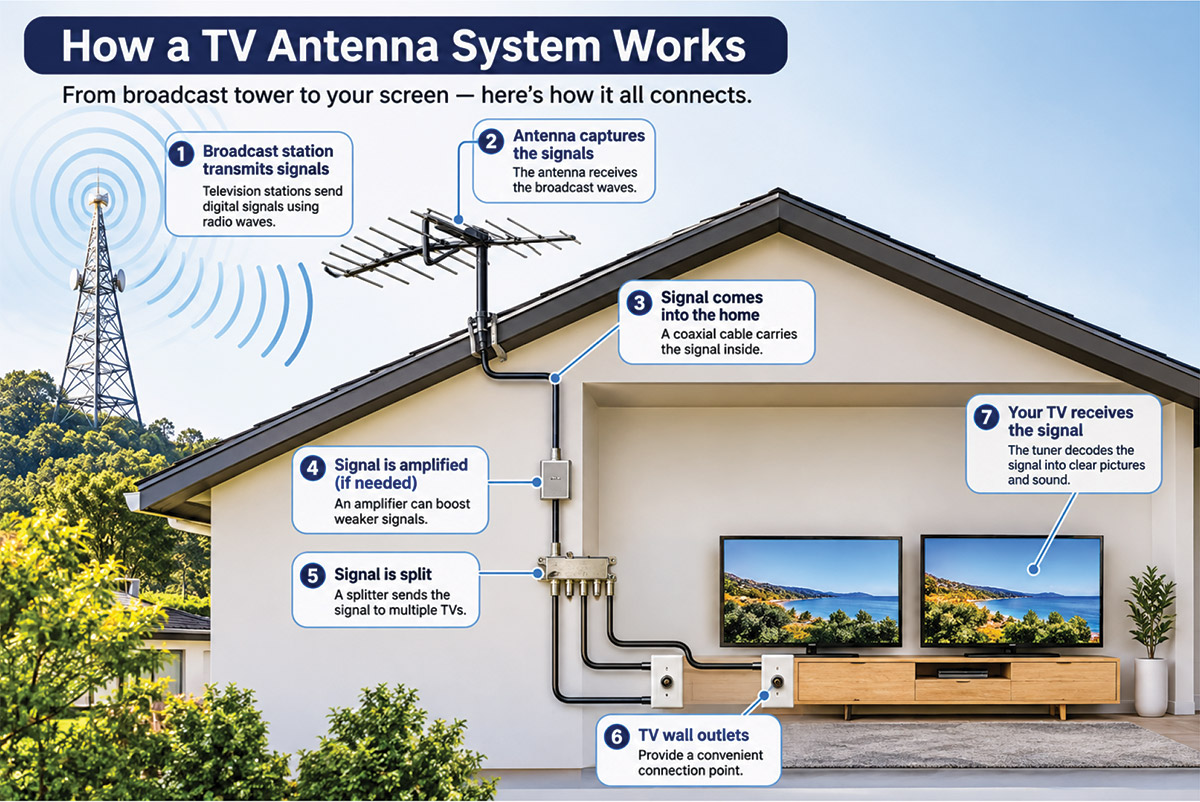
A typical household TV antenna system consists of several interconnected components:
| Component | Purpose |
|---|---|
| TV Antenna | Captures television broadcast signals from nearby transmitters. |
| Mounting mast and bracket | Holds the antenna securely in an elevated position. |
| Coaxial cable | Carries the received signal from the antenna into the home. |
| Signal amplifier | Increases signal levels when additional amplification is necessary. |
| Signal splitter | Distributes the incoming signal to multiple televisions. |
| TV wall outlet | Provides a convenient connection between the household cabling and television. |
| Television tuner | Receives and decodes digital broadcast signals for viewing. |
One component worth understanding is the coaxial cable. Unlike ordinary electrical wiring, coaxial cables are specifically designed to carry radio-frequency signals while protecting them from external interference.
For Australian household installations, the ACMA recommends quad-shield RG6 coaxial cable for connecting antennas to televisions. TV wall outlets are another important part of the system, providing accessible connection points in different rooms without running exposed cables across living spaces.
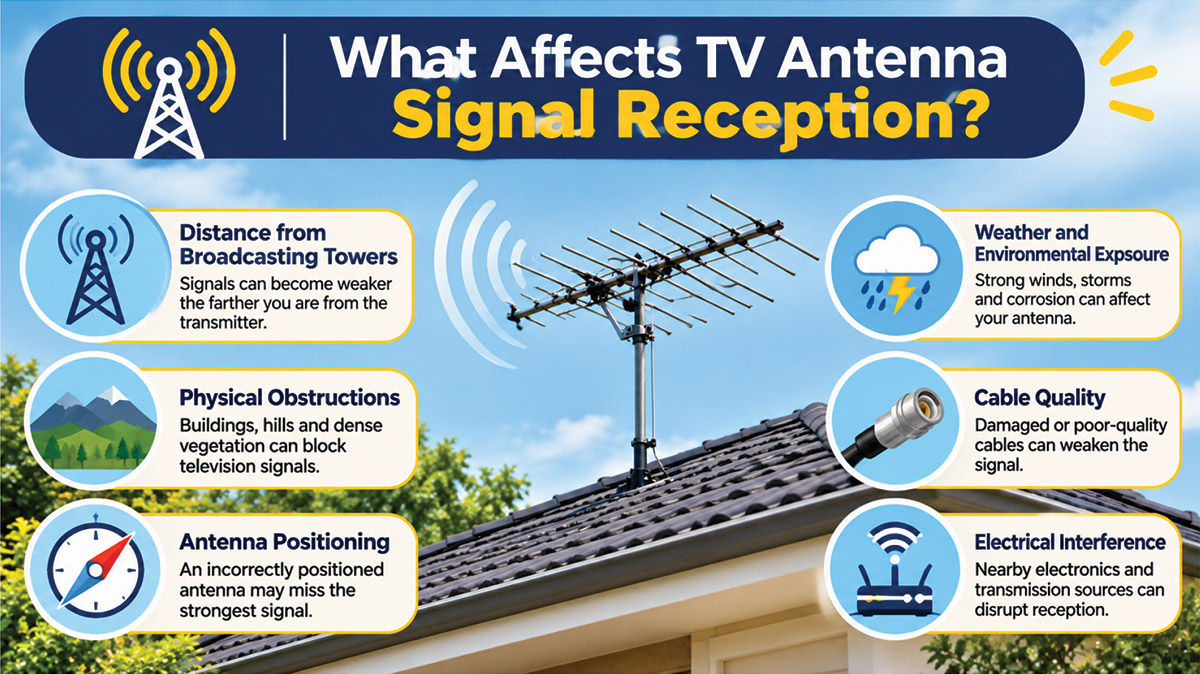
A number of factors can affect how well your antenna receives a television signal:
Television signals generally become weaker as they travel farther from their transmission source. Homes located far from broadcasting towers may require an antenna with suitable gain and positioning to receive reliable signals.
Buildings, hills, mountains and dense vegetation can obstruct or weaken incoming television signals. This is particularly relevant for properties located in valleys or areas surrounded by elevated terrain.
An antenna must be positioned and oriented appropriately to receive the strongest available signal. Incorrect alignment or insufficient installation height can contribute to poor reception.
Outdoor antennas are constantly exposed to environmental conditions. Strong winds, storms, corrosion and other forms of physical damage can affect their positioning and performance over time.
Damaged coaxial cables, loose connectors and poorly installed wall outlets can weaken the signal before it reaches the television. Excessively long cables and unnecessary splitters can also reduce signal levels.
Household appliances, electrical equipment and nearby radio transmissions can interfere with television reception. Mobile phone towers can also contribute to reception problems in certain circumstances, particularly when unsuitable amplification equipment is installed.
Common digital TV reception problems include:
Unlike traditional analogue television, which often displayed static or a snowy picture when reception weakened, digital television may experience sudden interruptions when the received signal becomes insufficient for reliable decoding.
Television antennas may appear relatively simple, but they play an important role in delivering free-to-air broadcasts to households. From capturing electromagnetic waves to transferring digital signals through coaxial cables and wall outlets, every component contributes to the overall performance of a television reception system.
Reliable reception depends on more than simply having an antenna mounted on the roof. Correct positioning, suitable equipment, quality cabling and properly installed connections all help ensure that television signals reach the receiver effectively.
A TV antenna is more than a few metal rods on the roof. It is the first link in a chain of components - antenna, cable, splitters, wall outlets and tuner - that work together to deliver free-to-air television to your screen.
For homeowners experiencing persistent reception problems or planning to install additional television outlets, understanding how these systems work is a useful first step towards making informed decisions. With the right equipment and professional installation where necessary, households can enjoy more consistent television reception and get the most out of their home entertainment systems.









Check out our amazing 9 STAR QUALITY GUARANTEE